
5 Reasons Why Filing Your ITR is Important in India
BASICS OF INCOME TAX
Kishna Agrawal
4/1/20263 min read
Introduction
In India, filing an Income Tax Return (ITR) is often viewed as a mandatory annual task that must be completed to stay compliant with the law. While it is true that individuals meeting certain income thresholds are legally required to file, the benefits of doing so extend far beyond mere legal compliance.
Even for those whose income falls below the taxable limit, filing a "Nil Return" can be a strategic financial move. Here are five significant reasons why filing your ITR is essential for your financial health and future opportunities.
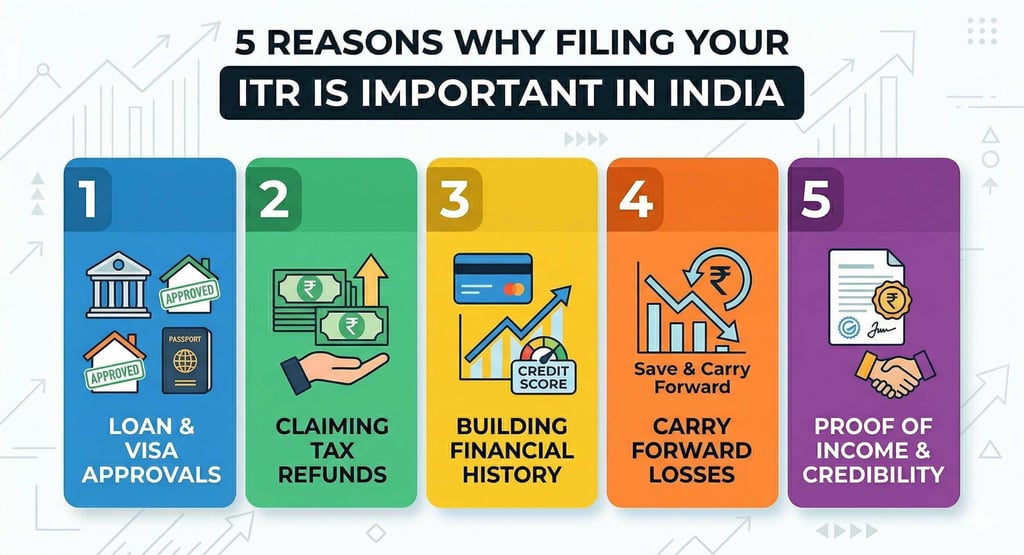
1. Loan and Visa Approvals
One of the most practical reasons to maintain a consistent record of ITR filings is to facilitate smooth loan and visa applications.
Loan Processing: When you apply for a home loan, car loan, or personal loan, banks and financial institutions typically require the last three years of ITR receipts. These documents serve as a validated record of your income and your ability to repay the debt. Without them, getting a loan sanctioned can become significantly more difficult or result in higher interest rates.
Visa Applications: Many foreign consulates (especially for the US, UK, Canada, and Schengen countries) require ITR receipts as part of the visa documentation process. It acts as proof that you have a steady income in India and are a tax-compliant citizen, which increases your credibility as a traveler.
2. Claiming Tax Refunds
Throughout the year, tax may be deducted from your income at the source (TDS) by your employer, bank, or other entities. Sometimes, the total TDS deducted might exceed your actual tax liability for the financial year.
The only way to get this excess money back is by filing an ITR. Once the Income Tax Department processes your return and verifies that you have paid more tax than required, the refund amount is credited directly to your validated bank account.
3. Building Financial History
An ITR is arguably the most authentic document for establishing your financial track record in India. It provides a year-on-year consolidated view of your earnings from various sources, such as salary, business, interest, or capital gains.
For self-employed individuals and freelancers who do not have a Form 16, the ITR is the primary document used to prove their income. A consistent filing history builds a strong financial profile, making it easier to engage in high-value transactions or investments in the future.
4. Carry Forward of Losses
The Income Tax Act allows taxpayers to carry forward certain types of losses to future years to offset them against future profits. This can significantly reduce your tax liability in subsequent years.
However, you can only avail of this benefit if you file your ITR within the original due date. Common losses that can be carried forward include:
Capital losses (Short-term or Long-term)
Business or professional losses
Losses from house property (though some conditions apply even for late filers here, it is best to file on time).
5. Proof of Income and Credibility
Beyond banks and consulates, the ITR serves as a standard proof of income in various other legal and financial situations. Whether you are applying for a high-value insurance policy, registering as a government contractor, or even participating in certain legal proceedings, the ITR is often the "go-to" document to establish your earning capacity.
Furthermore, being a regular tax filer enhances your overall credibility as a responsible citizen. It demonstrates that you are transparent about your finances and are contributing to the nation's development.
Conclusion
Filing your Income Tax Return should not be seen merely as a burden. It is a powerful tool that helps you claim refunds, secure loans, travel abroad, and manage your financial losses effectively. By filing on time, you ensure that your financial journey remains smooth and documented.
Disclaimer: This article is for informational purposes only. Tax laws are subject to change. It is recommended to consult a qualified tax professional or Chartered Accountant for advice specific to your situation.